ON-SITE
/PROJECT_INFO
/OVERVIEW
On-Site is a six-issue art newspaper and spatial installation produced in collaboration with Shangqi. Released throughout the six months preceding the 2017 Bi-City Biennale of Urbanism/Architecture, the publication allowed the exhibition to enter the city through printing, distribution, and reading before its official opening. Bai developed the visual system, art direction, and exhibition presentation, transforming the gallery into a workshop resembling an underground newspaper press. The project treats visual design as an infrastructure connecting multiple voices, production processes, and public circulation.
/FULL_PROJECT_TEXT
Collaborating organization: Shangqi Zhiwei Bai was responsible for the visual system, art direction of all six issues, and the overall spatial presentation. The texts, editorial work, and curatorial content were developed by Shangqi.
On-Site was a collaborative publishing project initiated approximately six months before the opening of the 2017 Bi-City Biennale of Urbanism\Architecture. Responding to Nantou Ancient Town and Shenzhen’s ongoing urban transformation, Shangqi organized a continuing body of artistic and curatorial content that was released through six issues of a newspaper titled On-Site. Bai developed the publication’s visual system and art direction, allowing changing subjects, images, and texts to retain a recognizable identity across successive issues.
“On-site” names both the publication and the project’s mode of operation. Rather than waiting for the official opening of the exhibition, the newspapers entered the city gradually throughout the preparation period. Each issue became a provisional presentation of an exhibition that had not yet been completed, allowing artistic content to leave the institutional venue in advance through printing, distribution, reading, and retention.
This method altered the conventional temporal structure in which an exhibition is completed before being opened to the public. The project emerged repeatedly through six publishing moments spread across approximately half a year. What readers encountered was not a retrospective catalogue summarizing a finished exhibition, but a set of temporary records that developed alongside the project and retained the information and decisions of different stages.
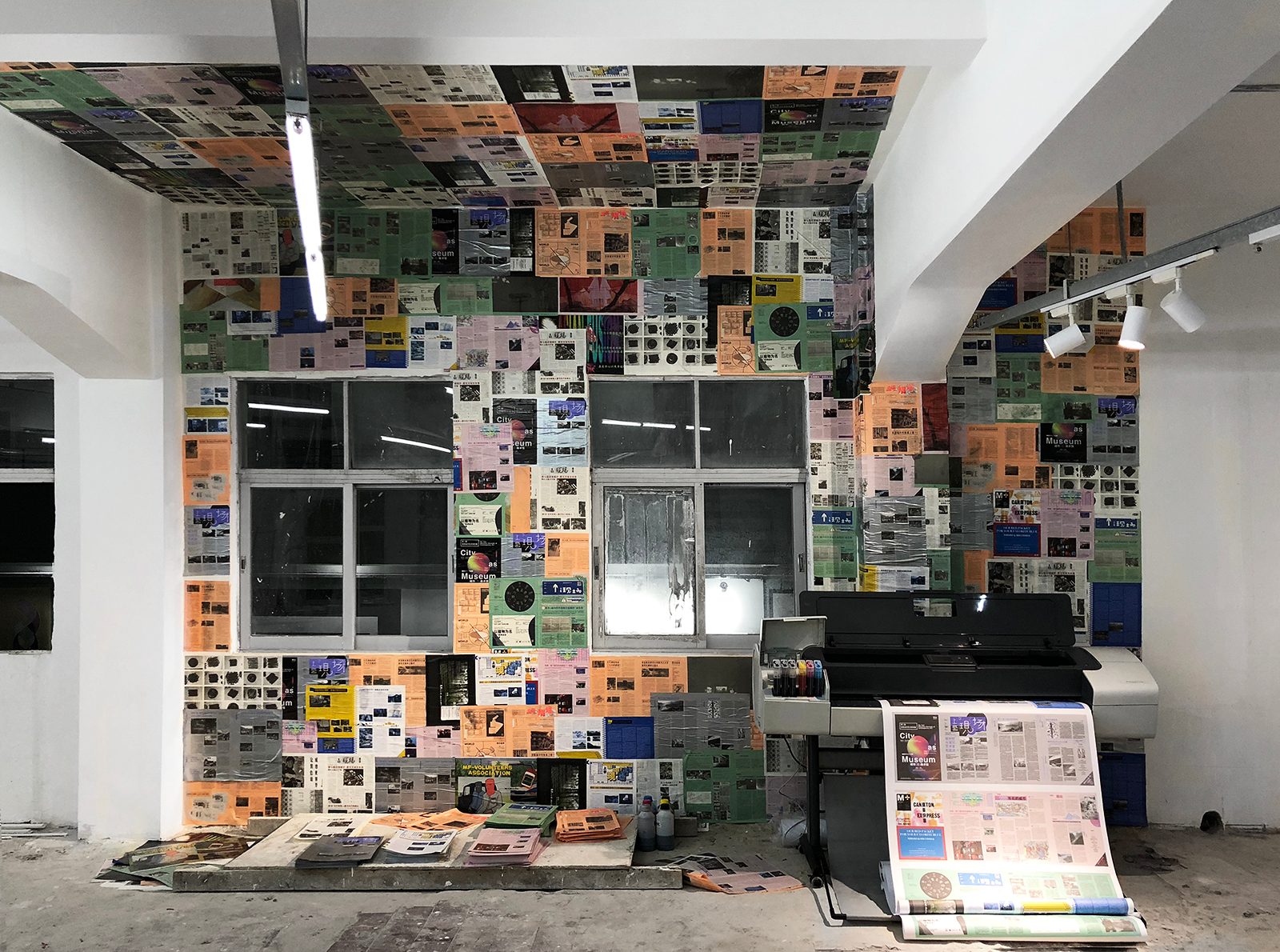
At the biennale, Bai transformed the exhibition space into a workshop resembling an underground newspaper printing room. Copies of the six issues covered walls, windows, and ceiling, while printing equipment, paper, ink, and scattered newspapers became part of the installation. The space ceased to function merely as a background for completed printed matter and instead became a site of production, reproduction, and circulation. Visitors encountered not only the newspaper’s content but also the conditions through which that content was manufactured and made public.
The dense repetition of newspapers across the surfaces disrupted the reading order of each individual issue. Headlines, images, paragraphs, and differently coloured papers overlapped, transforming the publication from a portable printed object into a spatial structure surrounding the visitor. Reading took place at two scales: one could approach and examine an individual newspaper or perceive the entire room as a proliferating surface of urban information.
Bai was not the sole author of the project’s texts or curatorial content. Through its visual system, publishing rhythm, and spatial organization, he established shared conditions through which the contributions of different authors and curators could appear together. This distinction is integral to the project. Its significance lies not in subsuming every contribution beneath a single artistic voice, but in treating visual design as an infrastructure capable of holding, connecting, and distributing multiple voices.
On-Site clearly defines Bai’s role within the collaboration. Rather than replacing editorial or curatorial authorship, he uses typography, visual systems, publishing rhythms, and spatial organization to establish shared conditions in which multiple voices can appear. The project thus transforms design from the packaging of a single message into an infrastructure connecting production, circulation, and public access.
/OVERVIEW
《在场》是与上启合作完成的六期艺术小报与空间装置。出版物在2017深港城市/建筑双城双年展开幕前半年陆续发行,使展览在正式开放之前便通过印刷、派发和阅读进入城市。柏志威负责视觉系统、艺术指导与现场呈现,并将展览空间转化为类似地下小报印刷室的工作坊。项目由此把视觉设计理解为连接多方内容、生产过程与公共传播的基础设施。
/FULL_PROJECT_TEXT
合作机构:上启
柏志威负责视觉系统、六期小报的艺术指导,以及展览空间的整体呈现;文字、编辑与策展内容由上启负责
《在场》是一项在2017深港城市/建筑双城双年展开幕前约半年启动的合作出版计划。项目以南头古城及深圳的城市变化为背景,由上启持续组织艺术与策展内容,并以名为《在场》的小报分六期陆续发布。柏志威负责整套出版物的视觉系统与艺术指导,使不同议题、图像和文字在持续变化中仍然保持可被辨认的出版身份。
“在场”既是小报的名称,也描述了项目的工作方式。出版物没有等到展览正式开幕后才出现,而是在筹备期间逐步进入城市。每一期小报都成为展览尚未完成时的一次临时呈现,使艺术内容通过印刷、派发、阅读和留存,提前离开展览场馆并进入日常环境。
这种工作方式改变了展览通常先完成、再向公众开放的时间结构。展览不再只是某个固定日期之后出现的结果,而是在半年间通过六次出版不断形成。读者接触到的也不是一份总结性的展览图录,而是一组与项目同步生长、保留不同阶段判断与信息的临时档案。
在双年展现场,柏志威将空间转化为一间类似地下小报印刷室的工作坊。六期出版物覆盖墙面、窗户与天花,印刷设备、纸张、油墨和散落的小报共同进入装置。空间不再只是展示已完成印刷品的背景,而成为生产、复制和传播发生的现场。观众看见的不只是小报内容,也包括内容如何被制造并进入公共流通。
小报重复铺贴所形成的密集表面,使单份出版物原有的阅读顺序被打散。标题、图像、段落与不同颜色的纸张互相覆盖,出版物由可以拿取阅读的平面媒介,转变为包围观众的空间结构。阅读因此在两种尺度间发生:观众既可以靠近一份具体小报,也可以把整个空间看作一张不断增殖的城市信息表面。
柏志威在项目中的角色并非策展文字或内容的唯一作者。他通过视觉系统、出版节奏和空间组织,为不同作者与策展内容建立共同的呈现条件。这一合作边界需要被明确,因为作品的意义恰恰不在个人表达覆盖所有内容,而在视觉设计如何成为容纳、连接和传播多方声音的基础设施。
《在场》清楚界定了柏志威在合作中的角色:他不替代编辑与策展内容,而通过排版、视觉系统、出版节奏和空间组织,为多方声音建立共同的出现条件。项目由此把设计从单一信息的包装,转化为连接生产、传播与公众进入方式的基础设施。
